
Shear Test Experiment
Introduction
Many engineering components are subjected to forces that tend to make one part of the material slide relative to another. Such forces produce shear stresses within the material.
Examples include bolts, rivets, pins, welded joints, structural connections, and machine components. The ability of a material to resist these sliding forces is measured by conducting a shear test.
A shear test is performed to determine the shear strength of a material, which is defined as the maximum shear stress the material can withstand before failure.
Physical Concept
When equal and opposite forces act parallel to a surface, the material experiences shear stress. The applied force tends to cause adjacent layers of the material to slide past one another.
In a direct shear test, the specimen is subjected to a load that produces shear across one or more planes until failure occurs.
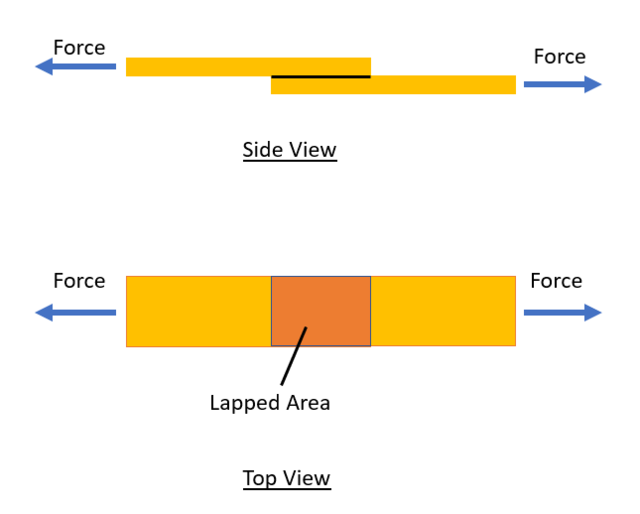
Two overlapping plates are subjected to equal and opposite forces. The load transfer occurs through the lapped area, producing shear stress along the contact plane. When the applied shear stress exceeds the shear strength of the material, failure occurs by shearing along the loaded plane.
Everyday Intuition
Shear action is commonly observed in everyday life.
Examples include:
- Cutting paper with scissors.
- Punching holes in metal sheets.
- Failure of bolts and rivets in structural connections.
- Sliding of joined components under load.
In each case, the applied force causes one portion of the material to move relative to another.
Experimental Relevance
The shear test is used to determine the ability of a material to resist shear forces.
The test helps determine:
- Ultimate shear load
- Shear stress
- Shear strength
- Failure characteristics
These properties are important in the design of bolts, rivets, pins, keys, couplings, and structural connections.
Single Shear and Double Shear
Single Shear
In single shear, failure occurs across one shear plane.
Examples:
- A single riveted connection
- A pin loaded across one section
Double Shear
In double shear, failure occurs across two shear planes simultaneously.
Examples:
- Double-riveted joints
- Pins loaded between two plates
For the same material and cross-sectional area, double shear can carry approximately twice the load of a comparable single shear arrangement.
Apparatus and Working Principle
The experiment is performed using a Universal Testing Machine (UTM) equipped with a shear test fixture.
The setup generally consists of:
- Shear test fixture
- Loading arrangement
- Test specimen
- Load measuring system
The specimen is placed in the fixture and subjected to a gradually increasing load until shear failure occurs. The maximum load sustained before failure is recorded.
Mathematical Formulation
Shear Stress
Shear stress is defined as the applied shear force divided by the resisting shear area.
where:
- = Shear stress (N/mm² or MPa)
- = Applied load (N)
- = Shear area (mm²)
Shear Area for Circular Specimens
For a specimen of diameter :
Shear Strength in Double Shear
For double shear, the resisting area becomes:
Therefore,
where:
- = Failure load
- = Cross-sectional area of one shear plane
Failure of Materials in Shear
Ductile Materials
Examples:
- Mild steel
- Aluminium
- Copper
Characteristics:
- Undergo noticeable deformation before failure.
- Exhibit relatively large shear strain.
Brittle Materials
Examples:
- Cast iron
- Ceramics
Characteristics:
- Fail suddenly with little deformation.
- Exhibit lower shear ductility.
Engineering Significance
Knowledge of shear strength is essential in engineering design.
The results of shear testing are used for:
- Design of bolts and rivets
- Design of pinned connections
- Structural steel connections
- Mechanical couplings and keys
- Fasteners and joining elements
Therefore, shear testing is an important method for evaluating the load-carrying capacity and safety of engineering components subjected to shear forces.